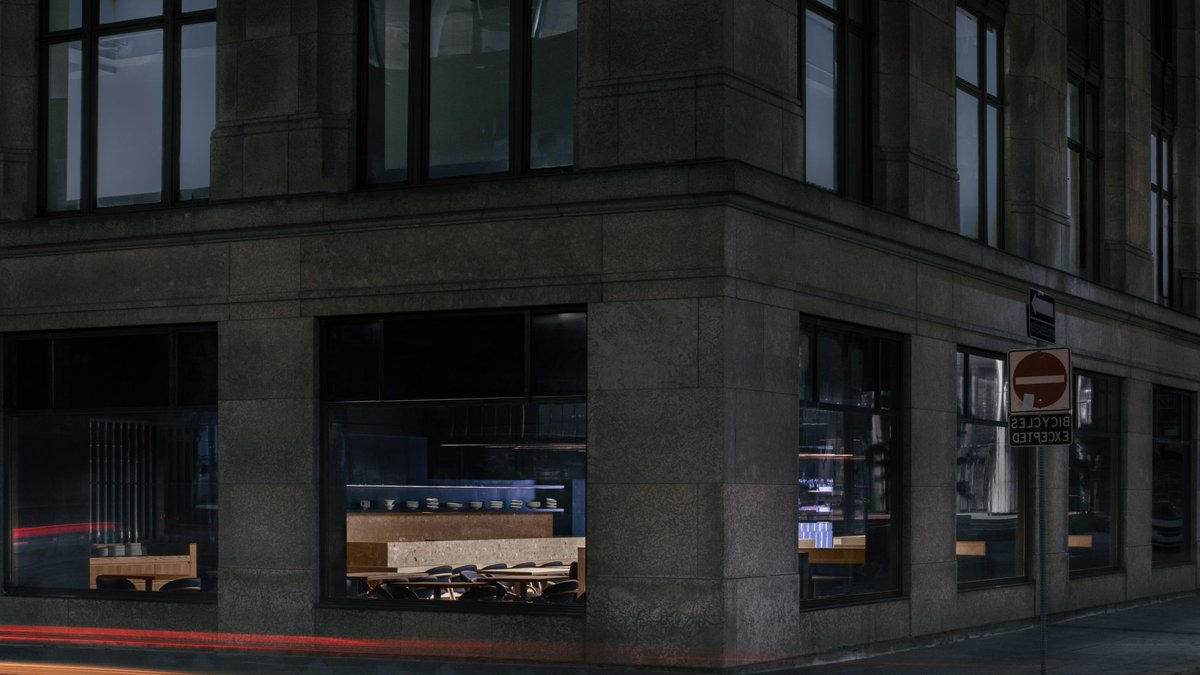
Steakhouses in Toronto usually lean on dark wood and moody lighting to set the mood. Shinji takes a different path, drawing its design language from Japan’s denim industry. The concept might sound odd at first glance, but it works. Denim is a fabric that balances humility with refinement. It serves as both workwear and high fashion. Its character comes from wear, time, and repeated use. These same values—craft, longevity, and material honesty—underpin the restaurant’s approach to hospitality.
A Threshold Before the Table
The design begins before guests even enter the dining room. Created by Harlo Entertainment, a Toronto studio founded by Aránzazu González Bernardo and Michael Fohring, the space avoids typical Japanese interior clichés. There are no shoji screens or sculptural noren. Instead, guests ascend a ramp lined with blue-stained wood and acoustic paneling. This route peels away from the busy activity of Bay Street. It acts as a threshold, slowing the pace of arrival and building a sense of anticipation.
Inside, deep indigo limewash wraps the walls and ceiling. It is perceived less as a color and more as ink or shadow. Custom-stained ash and pale stone add warmth and tactility. Overhead, a suspended field of acoustic baffles recalls the texture of woven textile. Beneath this, a continuous array of linear pendants forms an illuminated plane above the center of the room. The light does structural work here, organizing an expansive footprint into something that reads as intimate. It is a quiet, deliberate choice that sets the tone for the meal ahead.
Proximity and Precision
At the center of the space, guests gather around a grill. Food is prepared within arm’s reach of those about to eat it. This arrangement borrows the closeness of small Japanese dining rooms. It emphasizes the direct relationship between chef and guest, minus the theatre. It is not about spectacle. It is about the ordinary act of sharing space with the person cooking. Executive Chef Jia Zou works ingredient-first, treating Japanese wagyu and certified Kobe beef with minimal intervention. Fish, shiso flowers, and kinome leaves are flown in from Japan weekly. This supply chain ensures freshness and fidelity to the source material.
This approach mirrors a broader shift in fine dining where the distance between kitchen and table is shrinking. In many high-end establishments, the kitchen remains a hidden, separate entity. Here, the physical proximity forces a different dynamic. The guest is not an audience watching a performance. They are part of the environment where the food is made. This shifts the focus from the chef’s ego to the shared experience of the meal itself.
Restraint with a Single Rupture
The design maintains a strict sense of restraint throughout the main dining area. However, this discipline breaks precisely once. The corridor to the washrooms terminates in saturated pink light. This is a nod to Japanese nightlife districts and karaoke bars. Positioned as a destination in its own right, it acts as a well-judged rupture. It stops a disciplined interior from tipping into piety. The contrast is sharp, but it feels intentional rather than jarring.
Guests can order à la carte or choose from chef’s choice menus. An omakase-style experience built around the grill is also available. Zou explains the inspiration behind the menu and the design. “We spent a lot of time travelling through Japan, eating everywhere we could, from neighbourhood spots to some of the country’s best restaurants,” says Zou. “What stayed with us wasn’t just the food, but the care that went into every meal.”
The concept of shokunin—craftsmanship, precision, and respect for the ingredient, runs through both the design and the kitchen. Denim becomes limewash. Craft becomes detail. The grill becomes a reason to sit close to strangers. Shinji makes the quietly persuasive case that cultural identity doesn’t need to be depicted to be felt. The photography by John Alunan captures this subtlety, highlighting the textures and the interplay of light. It is a space that rewards attention. It asks guests to slow down, look closer, and appreciate the material honesty of the room. The result is a dining experience that feels grounded, thoughtful, and distinctly its own.


