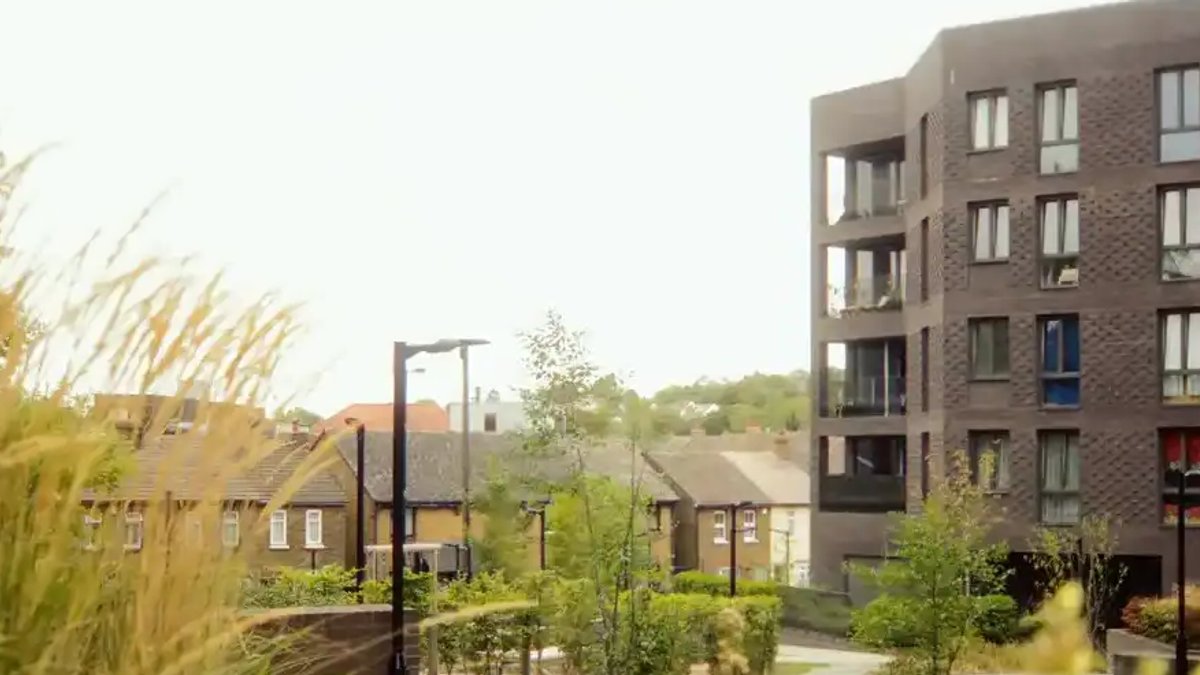
The RIBA Stirling Prize 2026 has been awarded to Lion Green Road, a council-commissioned housing scheme in Coulsdon, South London, designed by Mary Duggan Architects in partnership with RUFFARCHITECTS. The project, delivered for Croydon Council, provides 157 homes—a mix of privately owned and socially rented units—on land previously used as a car park. The jury recognized its ability to transform a steep, 8-meter-high slope into a unified, community-oriented development.
The scheme reimagines suburban density by using the site’s natural contours as its foundation. Instead of leveling the terrain or imposing rigid layouts, the architects arranged five pavilion-style blocks at different heights and angles. Each block shares the same structural framework but is rotated to frame views, some toward the historic Surrey Iron Railway, a remnant of the world’s first independent public railway. This approach creates a natural integration where buildings appear to rise from the land rather than overwhelm it.
Three muted brick tones unify the exteriors, while subtle variations in pattern and texture distinguish each building. Inside, every home features dual-aspect design, maximizing natural light and privacy. Balconies are positioned to prevent overlooking, allowing closer spacing without compromising residents’ comfort. The result delivers high density through intentional planning rather than forced efficiency.
A network of shared outdoor spaces, play areas, sensory trails, and allotments, connects the site, strengthening community bonds. The environment strategy preserves existing wildlife while introducing recreational and educational opportunities. The jury described it as a rare example where architectural innovation aligns with social benefit, addressing housing shortages without sacrificing quality.
He highlighted its balance of privacy, shared spaces, and connection to nature, qualities often neglected in large-scale housing. The scheme’s effectiveness stems from its deliberate variations: adjusted heights, brickwork details, and communal areas that encourage interaction while avoiding uniformity.
Mary Duggan, lead architect, described the project as a response to modern housing demands. She emphasized how the development transforms a challenging suburban site into 157 homes woven through a mature, accessible environment, using topography, shared space and carefully calibrated thresholds to support a rich culture of dwelling. The significance of Lion Green Road lies in what it says about the future of housing: that architectural ambition, social value and generosity can co-exist within the realities of contemporary development.
The RIBA International Prize 2026 and additional Special Awards were announced alongside the Stirling Prize, but Lion Green Road stood out for its ability to address both housing quantity and quality. Its approach, grounded in site responsiveness, sustainability, and community, serves as a model for future projects in an era of high demand.
The winning scheme was revealed at a ceremony on October 15 at Old Billingsgate, London. The jury emphasized how it redefines suburban living while maintaining privacy and environmental responsibility.
The Stirling Prize shortlist included projects such as a house at Fairmead, High Beach, Epping Forest by Sergison Bates; BEAM, Hertfordshire, by Bennetts Associates; Paddington Square by Renzo Piano Building Workshop (Paris) in collaboration with Adamson Associates (London); Pembroke, Mill Lane by Haworth Tompkins; River Wing, Clare College by Witherford Watson Ma; and The Buttermarket by Architectural Thread.