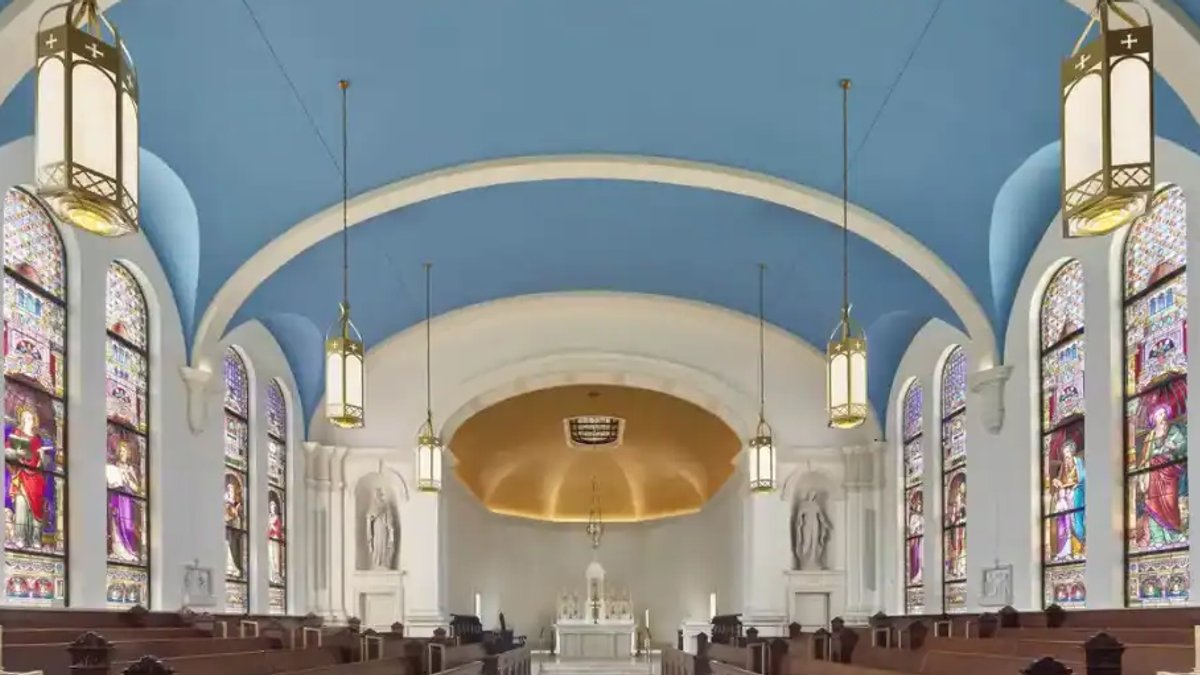
The Immaculate Conception Chapel opens at St. Charles Borromeo Seminary in Ambler, Pennsylvania. The 4,000-square-foot sanctuary replaces the seminary’s former Overbrook campus and serves a community that has worshipped on the same grounds for 155 years.
The seminary’s move to a 150,000 sf campus required a consolidated space that could host classrooms, a library, residences and a central worship area. This new campus needed a dedicated venue for daily prayer, formation and larger liturgical celebrations, which the chapel now provides.
Seating Layout Balances Intimacy and Capacity
Seating for 220 people is arranged in a nave with tiered antiphonal benches that face a central aisle. A wide choir balcony adds extra seats for faculty, staff and guests, allowing the space to expand for major feasts without compromising intimacy.
Architects drew the vaulted ceiling from the two chapels that once stood at the Overbrook site. Twelve stained-glass windows now line the nave walls, while a single window crowns the chancel ceiling, filtering colored light onto refurbished pews and choir stalls. The design of the ceiling and windows is a nod to the seminary’s heritage.
The marble altar and ambo were rebuilt using fragments from several historic altars, creating a unified focal point. Restored statuary— the Stations of the Cross, a Blessed Virgin Mary, and St. Joseph—occupy niches that echo the original layout. The architects incorporated these elements to maintain a sense of continuity with the past.
In the narthex, a Marian shrine, the Drexel Crucifix and a holy-water font welcome worshippers. A new bell tower houses the seminary’s historic bell, which will resume its traditional weekday ringing.
Heritage Elements Support Seminarians’ Formation
For seminarians, the blend of reclaimed art and modern form provides a tangible link to the institution’s past while supporting contemporary formation. The familiar icons and sounds reinforce a sense of continuity.
Read Also: Toronto college opens new student life centre
The chapel features a new pipe organ, Opus 64, equipped with two manuals, 23 ranks and 43 stops. Its tone supports both chant and congregational singing, filling the vaulted space with resonant sound.
Modern audiovisual systems stream the daily Divine Office to adjacent classrooms and to remote listeners, extending the liturgical life beyond the stone walls.
A processional aisle runs the length of the sanctuary, shaping the rhythm of entrance and exit rites. The floor includes a Miraculous Medal inlay, reinforcing the chapel’s dedication to the Blessed Virgin Mary under the title of the Immaculate Conception.
The chapel was consecrated on a Marian feast day, aligning its spiritual purpose with its architectural symbolism. Throughout the year, the restored bell will ring from its new tower each weekday at 7 a.m., marking the start of the seminary’s daily schedule.
Located at 1400 Evans Road, the chapel’s construction concluded in the year preceding its dedication.
Design and Engineering Teams Behind the Chapel
Design responsibilities fell to the architectural practice, while interior design remained in-house, ensuring continuity of vision. Voith & Mactavish Architects led the design effort, with the seminary handling interior design.
Structural stability was achieved through collaboration with O’Donnell & Naccarato, whose engineering solutions addressed the vaulted ceiling’s load.
Mechanical, electrical and plumbing systems were coordinated by Alderson Engineering, integrating modern climate control.
Read Also: Oxford Street Begins Pedestrian-Only Transformation
Civil infrastructure, including site grading and access pathways, was handled by Bohler Engineering, linking the chapel to the surrounding campus.
Acoustic performance received special attention from Acentech.
Owner representation was provided by Aegis Property Group, overseeing compliance with the seminary’s functional requirements.
Construction management duties were executed by W.S. Cumby.
Design draws upon traditional building principles, translating them into a contemporary worship environment.
Integration with the Student Life Center positions the chapel as a daily focal point for formation, linking academic and spiritual rhythms.
Audio-visual infrastructure extends liturgical events beyond the walls, allowing remote participation.


