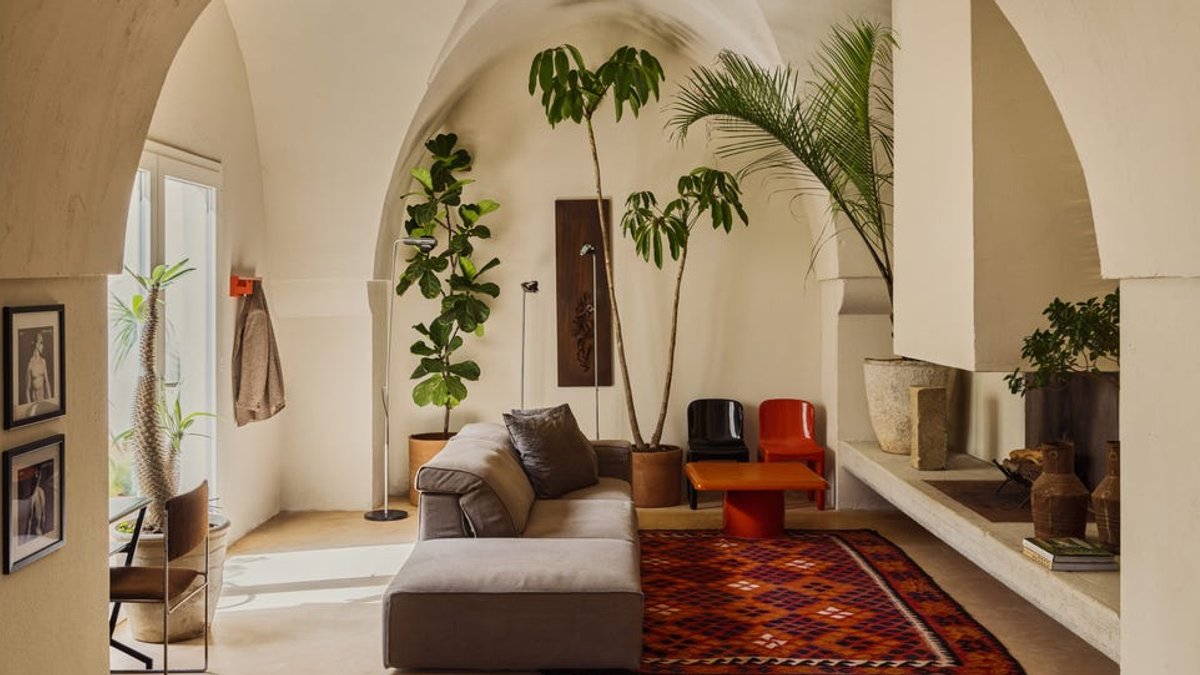
Gabriele Fanuli didn’t plan to redesign his home in Salento. He treated the 100-square-meter space like a garden—something to observe, shape, and let evolve.
“I never thought of this house as something to be rewritten,” he said. “It was a structure to be listened to.” The building kept its original features—arches, vaults, and proportions. Fanuli removed excess, allowing light and air to move freely through the rooms.
Where architecture meets horticulture
The house removes clear divisions between inside and outside. Shifts in materials and levels define spaces instead of walls. Plants serve as structural elements, adding height and softening transitions between vaulted ceilings and human scale. The effect feels fluid, like walking through a setting where paths merge naturally.
The setting architect applied the same principles he uses outdoors: balance solids and voids, plan for growth, and accept change. “The climate of Copertino and the light of Salento enter the spaces,” he said. “I tried not to block them.”
Color appears in small, deliberate accents that create tension without disrupting the neutral palette. Furniture mixes styles—contemporary elements sit alongside reclaimed objects, their soft forms and playful freedom evoking affinities with 1960s and 1970s design. “The design doesn’t take itself too seriously,” Fanuli noted. “This is a place that’s instinctive, not rigid.”
Related: Spain’s design stars shine after victory
The most striking elements aren’t the obvious details but the in-between spaces—the voids and transitions. “I’m drawn to spaces that seem unused,” he said. “They make everything else feel lighter.” Like a garden, the house grows and transforms over time.
This philosophy extends beyond the home. Fanuli’s project, RinVaso Design, rescues discarded pots and plants, giving them new life in other gardens. “It’s about second chances,” he explained. The house follows the same idea.
A home that breathes
The line between inside and outside blurs. Greenery crosses thresholds, and materials like stone, terracotta, and plaster reflect the surrounding environment. The result isn’t a bold statement but a quiet argument for design as an act of respect and durability.
Fanuli’s work focuses on transformation, not permanence. The house doesn’t demand attention—it encourages slowing down to notice how light shifts across a wall or how a single plant alters a room’s feel. It’s a space that evolves alongside its inhabitants.
Like a well-tended garden, it doesn’t need to justify itself.


