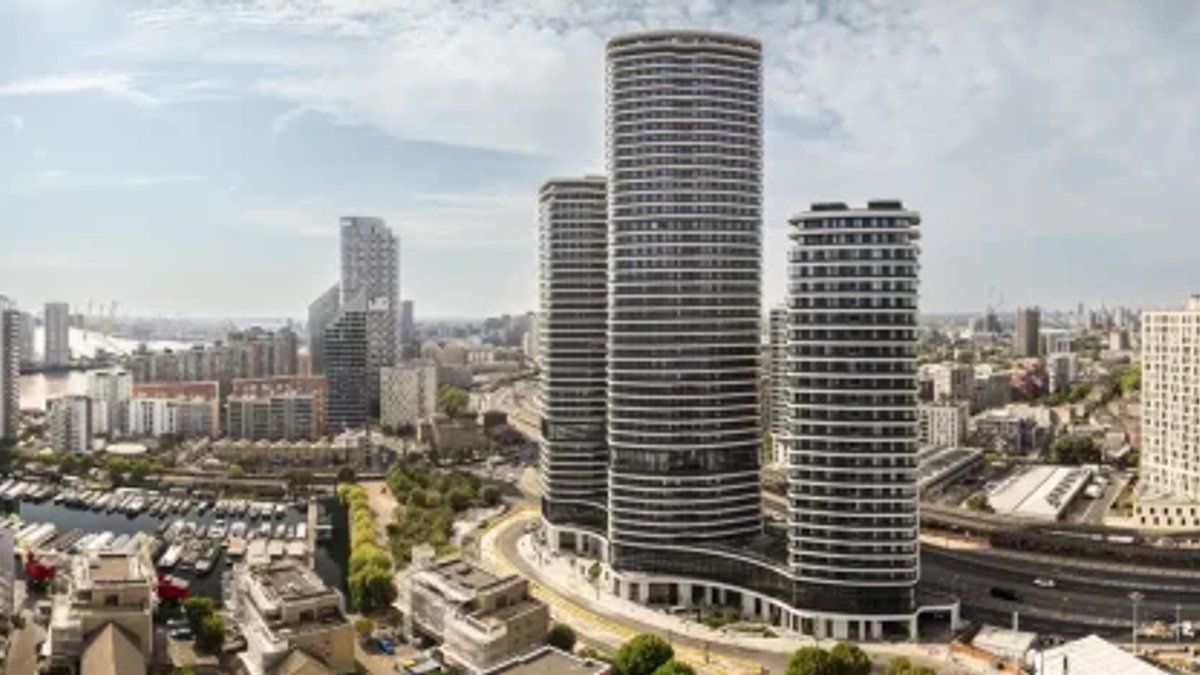
The urbanest Canary Wharf development, situated in London’s Canary Wharf, has earned Passivhaus certification, securing its place as both the world’s tallest Passivhaus building and the largest Passivhaus-certified residential structure. Designed by Apt Architects, the project features three towers standing at 46, 36, and 28 storeys.
This certification awards the project two global distinctions: it is the tallest fully Passivhaus-certified building worldwide and the largest Passivhaus-certified residential building. Additionally, it holds the title of the UK’s largest single Passivhaus-certified structure and the country’s tallest purpose-built student accommodation (PBSA).
Development Details
Opened in September under an agreement with University College London (UCL), the Canary Wharf development includes 1,672 student bedspaces and 80 residential units, ranging from one to three bedrooms. It also offers 43,000 sq ft of retail, education, and office space, along with a drive-thru McDonald’s restaurant.
The Passivhaus standard ensures exceptional energy efficiency, enhanced resident comfort, and improved indoor air quality, significantly reducing heating and cooling energy demands compared to typical new builds. urbanest Canary Wharf achieved this through high insulation, airtight construction, advanced glazing, and heat-recovery ventilation systems.
Sustainability Features
Residents benefit from year-round comfortable temperatures and a constant supply of fresh, filtered air, alongside reduced energy consumption. The development also features a gym, yoga studio, cinema rooms, study areas, games rooms, communal spaces, and 70 sky gardens to enhance student wellbeing.
Delivered in partnership with UCL, the project involved collaboration with JRL Group, Apt Architects, Henriksen Studio, Newmark, Walsh, Rider Levett Bucknall, MTT, and LDA Design. The certification was celebrated on 24 November, with the Passivhaus Institute presenting the official certificate to the project team at urbanest Canary Wharf.
Anthony Mellalieu, Chief Operating Officer at urbanest, stated: “urbanest Canary Wharf is setting new standards for sustainable student homes, taking our Passivhaus journey to new heights. Achieving this rigorously tested certification is a reflection of exceptional work from the entire project team.”
Its Passivhaus certification highlights its role as a leader in sustainable student accommodation, proving that high energy performance and quality living can coexist at scale.
The Passivhaus Institute certified the development after rigorous testing of its energy efficiency and sustainability features, marking a significant milestone in the project’s completion.
urbanest manages a portfolio of ten architect-designed properties in central London, providing over 6,000 beds. The company collaborates closely with leading universities to deliver a high-quality living experience for students.
urbanest Canary Wharf is the company’s second Passivhaus-certified development, following urbanest Battersea in 2024.
Company Background
urbanest, a Central London-focused REIT established in 2008, specializes in developing and operating premium purpose-built student accommodation. Supported by long-term pension fund capital, the company partners with universities to provide high-quality housing for students.
Laszlo Lepp, Managing Director of the Passivhaus Institute, remarked that certifying the largest Passivhaus project globally demonstrates the integration of sustainability and social responsibility. Thomas Henriksen, Founder and Director at Henriksen Studio, highlighted that urbanest Canary Wharf proves Passivhaus can be achieved at scale in complex, mixed-use urban projects.
Joe Lay, Director of Accommodation at UCL, noted that the development aligns with UCL’s accommodation strategy, offering high-quality, sustainable spaces near the School of Management for students to feel at home.


