I met the Australian architect Peter Stutchbury before I got to Bali. Same flight, same row, both of us headed to Jia Curated where he was speaking on the final day. He has built more than 150 projects and gives very little to the press, and there I was with seven hours of his brilliant mind all to myself somewhere over the Timor Sea. Sixteen years of doing this and I still can’t believe my luck sometimes.
At the time, that’s exactly what I thought it was. Luck. But as the week unfolded, I began to see that it was more than just serendipity. It was a sign to the unique ecosystem that Jia Curated had cultivated.
Jia Curated, as Budiman Ong, one of its founders, explained, is not a typical trade show or festival. It’s a creative evolving ecosystem, which is the only description I’ve heard that fits. Spread over five days, it hosted around 250 brands, a talks program, installations, live music, food, and a beach. This was the fifth edition and the first one on sand, blurring the lines between nature and design.
Jia means ‘home’ in Chinese, and Budiman saw Jia Curated as an exploration of what home means today. “We’ve complicated the idea of home,” he said. “Home is simple. Somewhere you’re comfortable, somewhere you feel at ease.” The event was reverse-engineered from this simple brief, creating a space where people could connect, relax, and enjoy good food and music.
This year’s Nature Weave theme took this idea further. It posited that we’re not outside nature admiring it, but inside it, dependent on it. Design, according to this philosophy, should be biophilic, intuitive, and coexist with settings, ecosystems, and other species. This was evident in the structures built for the event. Blancostudio and Kalpa Taru Bali’s Main Main Pavilion, for instance, was built around four raw teak slabs and custom game boards made from offcuts, fitting seamlessly into its beachside environment.
Project Benih, one of the most intriguing parts of Jia Curated, launched here. Benih means ‘seed’ in Indonesian, and the project pairs designers with artisans and manufacturers across Indonesia, Taiwan, and Japan. This year was just an introduction, with designers, makers, and manufacturers each represented by a piece of what they do. The matches will happen afterwards, with the resulting collection set to arrive in 2027.
Wandering through Project Benih, I found myself pairing designers and makers in my head, feeling excited about the possibilities. The show was housed in BaleBio, a beautiful regenerative bamboo structure by Cave Urban, and a model of the same building sat in the Architecture in Scale exhibition at the other end of the site. This exhibition brought together twenty-five models of completed buildings from Indonesia and across Asia.
Related: Bankston For Scale Advocate Touch Across Two Cities
One object that stood out to me was inside Project Benih. Chang Po-Chieh, from Zhēnzhēn Stained Glass Lab in Taiwan, showed two pieces from his Relight series in vintage patterned glass.
Material was the strongest thread running through the site. Ceramic tiles, textiles, and weaving – tactile traditions were taken somewhere new rather than given a respectful nod. Much of it would go straight into Australian and international projects looking for a point of difference, with real artisanal quality, and it comes out of a culture of making that Indonesia still has, and we largely don’t.
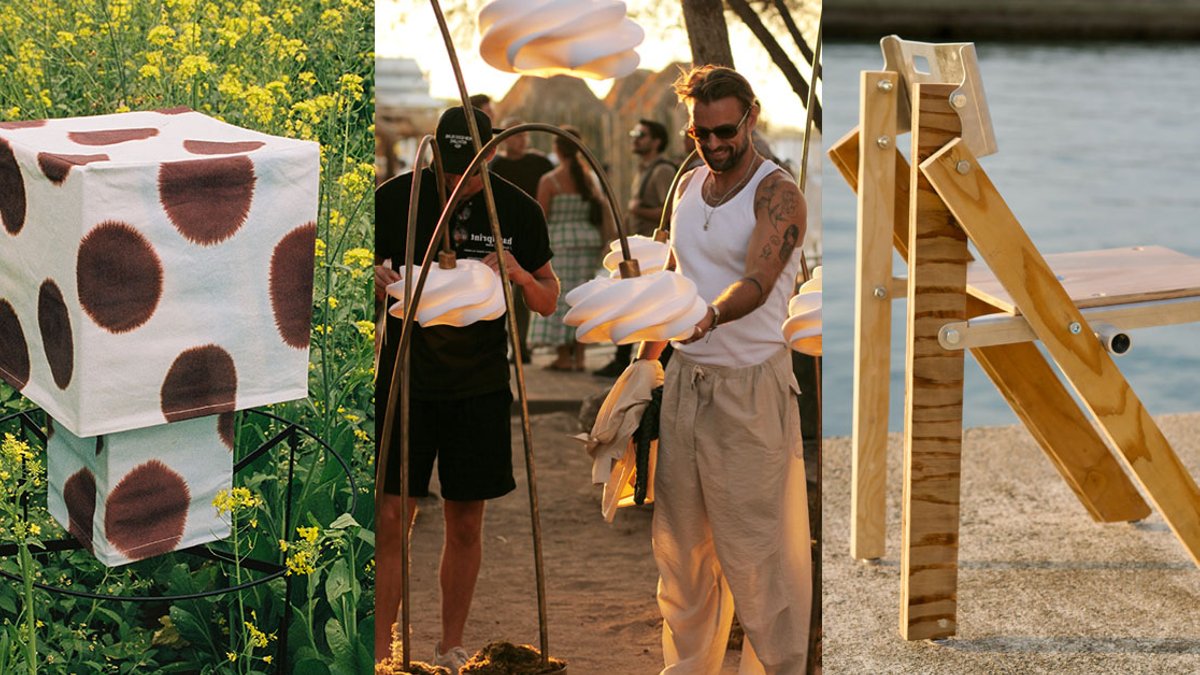
On the more experimental end, Bell Living Lab had made leather from coffee. At Wasted by Potato Head, Max Lamb was making caps from off-cut cardboard in front of anyone who stopped. But my favorite thing on the whole site was a chair. Sander Wassink’s V-Series, presented by Method Inc, starts as a handful of aluminum connectors and becomes whatever the place can give it. Three had come from Japan, two were built at Pengembak from timber salvaged from the venue itself, with Kaltimber. Visitors also made their own across several days, choosing and cutting the timber, helping each other assemble. Same structure underneath every one, but not one of them alike.
The talks program was also noteworthy. Budiman designed the stage himself, a bamboo structure standing in the water so that depending on the tide, the speakers’ feet were in it. Everyone spoke barefoot. The audience sat across the water on tiered scaffolding under umbrellas made of recycled material, and loudspeakers had been run right across the site, so the talks carried well past the seating and reached people who hadn’t come for them.
Design Anthology curated 360° Design Dialogues, and its editors hosted them. The program was the theme arriving by a different door – craft translated into contemporary objects, textiles as material research rather than decoration, the business of design, plus solo conversations with prominent figures in the design world. Fiona Lynch spoke with Jeremy Smart about her practice, and Peter Stutchbury closed the event on the last afternoon, in conversation with Suzy Annetta.
Stutchbury learned to read land at eleven, herding sheep on the family farm. He has been doing a version of that ever since. Papua taught him an intuitive response to shelter and how to live alongside people unlike himself, which he said generates our humanity. The reading of land over 350 million years, and our very small place in it. “Nature is the biggest teacher. It refreshes you. It always gives back,” he said.
He was saying all of this barefoot with the tide around his ankles, on a stage built to put him exactly there. If you set out to design an ending for an event about making things with the land rather than on top of it, I don’t know that you could do any better.


